My Recent Experience at a 4-Week Intensive Yoga Teacher Training Course
My Recent Experience at a 4-Week Intensive Yoga Teacher Training Course
Background
Yoga has been a huge comfort in my life; throughout my twenties, when life seemed unstable, a yoga flow rooted me to the earth. Yoga in fact led me to my current path of an Ayurvedic Practitioner, sharing traditional ancient Indian knowledge to help my clients balance their mind, body and spirit using lifestyle tips, herbs, food and therapies. I always knew I would do a Yoga Teacher Training Course (TTC) someday; when was the only unknown. Winter 2025 seemed like the right time; having a flexible daily job, escaping the chaos of Christmas and it also marked the end of a 7-year cycle in Numerology. Perfect!
The Lineage
I chose to do my TTC with the Sivananda Yoga Vedanta Centre. This style of yoga came into my life last summer while doing an Ayurvedic Detox Program in South India. Due to the Monsoon rains, low season meant there were only a handful of guests in my centre, one who happened to be a Sivanand Yoga Teacher. Practicing with her, I knew at once that this was the yoga for me.
A revered saint of modern times, Swami Sivananda is the inspiration behind the Sivananda Yoga Vedanta Centres. Born in South India he served as a medical doctor before renouncing worldly life and establishing an ashram in Rishikesh, North India in 1932.Though he never left India his teachings quickly spread internationally, leaving a legacy of love, peace and knowledge still unfolding today.
Swami Vishnudevananda was a student of Swami Sivananda and was sent as a young man to the West in 1957 by his guru to spread the teachings of yoga He was the first to introduce the concept of a yoga vacation and the first to establish yoga teachers’ training courses in the West. As a peace activist during the 1970s he flew over war-torn countries of the world in his brightly-coloured two-seater plane dropping flowers and leaflets for peace. On August 30, 1971, Vishnudevananda flew from Boston to Northern Ireland in his Peace Plane. His message, “Man is free as a bird”, challenged all man-made borders and mentally constructed boundaries between Catholics and Protestants, Republicans and Unionists. Upon landing, he was joined by actor Peter Sellers and they walked through the streets of Belfast chanting a song called “Love Thy Neighbour as Thyself.”
The Yoga
How is Sivananda yoga different from other traditions? What attracted me was the emphasis on breathwork, the prayers chanted at the beginning and end of every class and the structure of the class with its 12 basic postures. However, it was the short Savasanas or relaxations throughout the class, culminating with a final relaxation at the end, that really made the practice special to me. By nature, I am a busy person; busy body and busy mind. My least favourite part of every yoga class was relaxation at end. I just could not relax! Hearing the snores of fellow yogis beside me just made my mind more restless! Through the short relaxations between postures in a Sivananda class, my nervous system was being prepped for the final relaxation. My body became still, my mind became even stiller and my final relaxation allowed me to enter a state similar to deep sleep.
The Five Points of Yoga according to Swami Sivananda (Sivananda Yoga) are simple principles for healthy living of body, mind, and spirit. They also are useful to convey how Sivananda Yoga differs from other schools. Here is a clear, concise summary:
1. Proper Exercise (Asanas)
Yoga postures strengthen the body, improve flexibility, stimulate circulation, and prepare the body for meditation.
2. Proper Breathing (Pranayama)
Conscious breathing increases lung capacity, boosts energy (prana), calms the mind, and balances the nervous system.
3. Proper Relaxation (Savasana)
Deep relaxation releases physical and mental tension, allowing the body to recharge and heal.
4. Proper Diet (Vegetarian / Sattvic Diet)
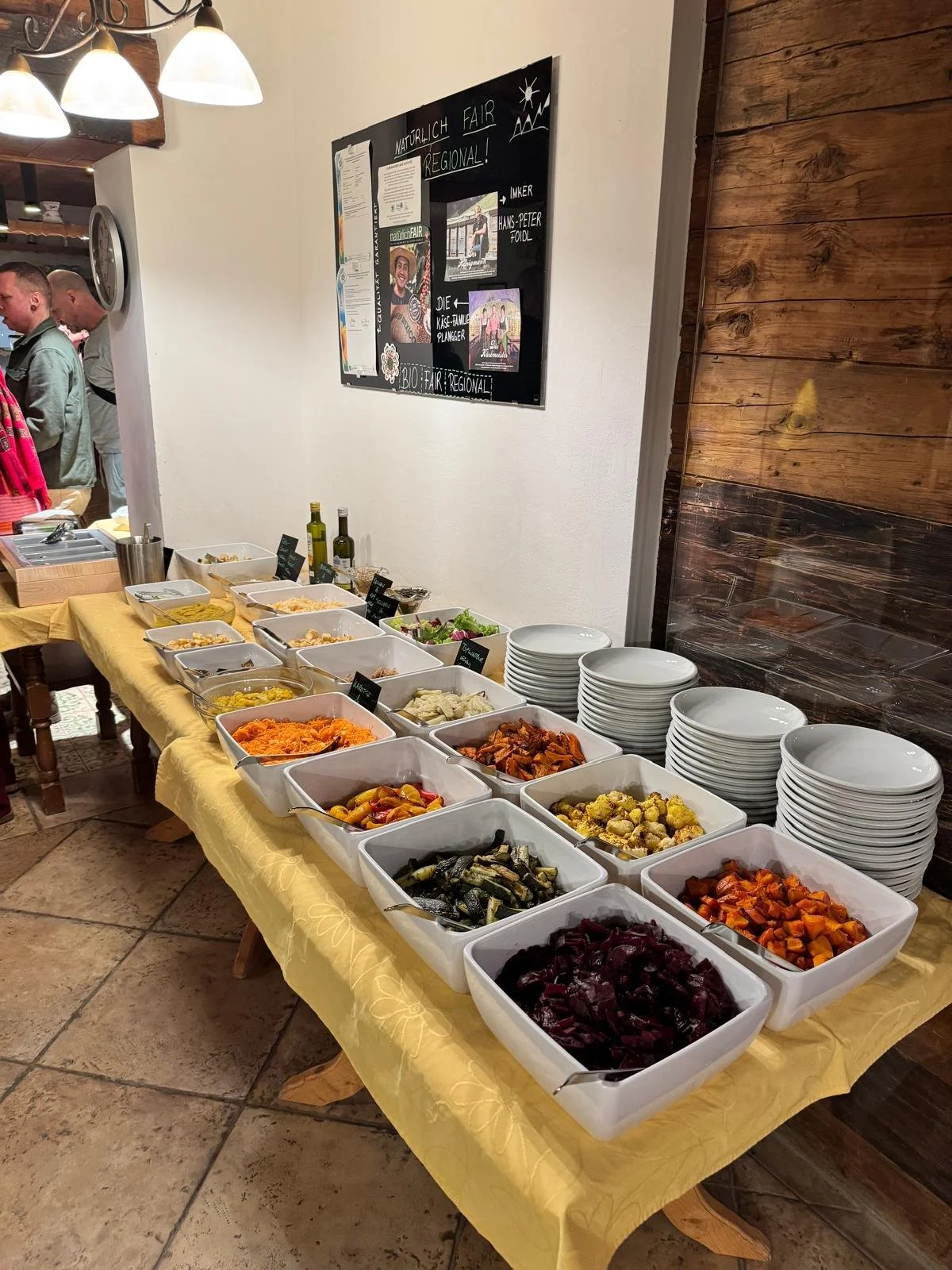
A pure, natural, plant-based diet nourishes the body, supports mental clarity, and promotes compassion.
5. Positive Thinking & Meditation (Vedanta & Dhyana)
Right thinking and meditation cultivate inner peace, concentration, self-awareness, and spiritual growth.
Think of it this way, you can compare the 5 Points to taking care of your car! You need to lubricate the car well so it can run smoothy (exercise), you must recharge the battery (breathing), feed it the correct fuel (diet), supply it with a cooling agent (relaxation) and make sure the driver is in control (positive thinking). Take care of yourself like you would your vehicle!
The Paths
Yoga, whose goal is to bring the individual to the realisation that their soul is part and the same as the world soul, has many different paths to help reach this realisation. Just like some people are more naturally suited to specific careers, some people are more suited to specific paths of yoga. However, balance is encouraged.
Type of Yoga
Suited for
Consists of
Karma
Active, service orientated
Doing acts of service for others without expectation of reward and without identifying as the doer, action in the name of the Divine
Bhakti
Emotional, heart-centred
Surrender to the Divine, devotional worship to various “Gods” via chanting, prayer, spiritual stories, rituals (but understanding that the “God” is just a representation of the world soul
Raja
Logical, scientific
Step by step approach of various techniques to control the mind via physical postures and breathing (Sivananda Yoga would come in this category)
Jnana
Philosophical
Answering questions such as “Who am I?” by discovering what one is not, study of the scriptures
Sivananda, and most other physical yoga posture disciplines, come under the category of Raja Yoga. The most famous Raja Yoga teacher was Patanjali who developed the Hatha Yoga system which created the famous 8 Limbs of Yoga;
1. Yama – Ethical restraints (how we relate to others)
2. Niyama – Personal observances (self-discipline and inner habits)
3. Asana – Physical postures to strengthen and prepare the body
4. Pranayama – Breath control to regulate life energy
5. Pratyahara – Withdrawal of the senses inward
6. Dharana – Concentration on a single point
7. Dhyana – Meditation, uninterrupted flow of awareness
8. Samadhi – Complete union with the world soul, state of enlightenment
The Philosophy
Surprisingly, or not, 70% of the TTC was dedicated to philosophy and not to physical postures. How to summarise in a paragraph all that I learned in my time there? Impossible. The main question of most philosophical systems is; Who am I? According to Vedanta (a style of Indian Philosophy), we are all part of a greater whole, we are the drops in the ocean, the blades of grass in the field, and that whole, ocean, field is called Brahman; we experience this life however as the part, the drop, the blade of grass and do not realise that we are the whole, the ocean, the field. In fact, there is no different between the part and the whole, the drop and the ocean, the blade of grass and the field. The are the same. We do not realise this sameness however because we identify with our body and our mind, instead of this oneness. Now for some terms for those interested; the whole is Brahman, the part is Atman (we are both Brahman and Atman) and the identification with the body and mind instead of Brahman/ Atman is Jiva, the body and mind being Upadis, or veils of illusion. Or in simple terms, our souls are eternal, infinite and absolute, and we all belong to the same universal soul. Our aim in life is to see through the veil of the body-mind and the limitations of time and space, and realise this universality. Meditation is a tool in which we can realise this.
Finally, our body is mortal so decomposes with death, but our souls do not. As stated, our soul’s mission is to identify with the universal soul, so it comes back life time after life time in hope of achieving this. Add to this the Law of Karma, that every action has a reaction. There is not enough time for us to exhaust all of our Karma, to live out the results of our actions, thus we are reincarnated into another body to bear the fruits of our actions. This is the Doctrine of Reincarnation.
The Physical Asanas
The Sivananda Yoga style is truly holistic. While in appearance it is a physical practice, at its core, it is a spiritual sadhana or endeavour-that of self-realisation, that we are souls part of the greater world soul.
Each class is about 90 minutes long and begins with a short relaxation laying down on the back and then chanting a prayer in Sanskrit, the ancient language of India, where one invokes the deities and other positive energies. Pranayama, or breathwork comes first and lasts about 20 or so minutes; practices include a fiery Kapalabati sequence, and a slower alternate nostril, or Anuloma Viloma breathing. These both have benefits for the mind, the respiratory system and cleanse the astral body. After another short relaxation, comes the warm up-Sun Salutation, or Surya Namaskar. The 6 or so rounds of flexion and extension of the whole spine ensure the body is lubricated well before starting into the various poses that follow. After another short relaxation (there is a short relaxation between each exercise!) comes the leg lifts to engage the core and stretch the muscles. What follows are the 12 basic postures in the following order; headstand, shoulder stand, plough, fish, seat forward fold, cobra, locust, bow, seated spinal twist, crow, peacock, forward fold and triangle. Alternative and variations can be practiced. The class finishes with a 15 minutes Final Relaxation which includes; physically relaxing the body via tensing and releasing body parts and auto-suggestions to relax the involuntary organs; mentally relaxing with guided breathing; and spiritual relaxation with visualisation and silence. Ending with the closing prayers, one leaves the class feeling the silence and peace within.
The Place
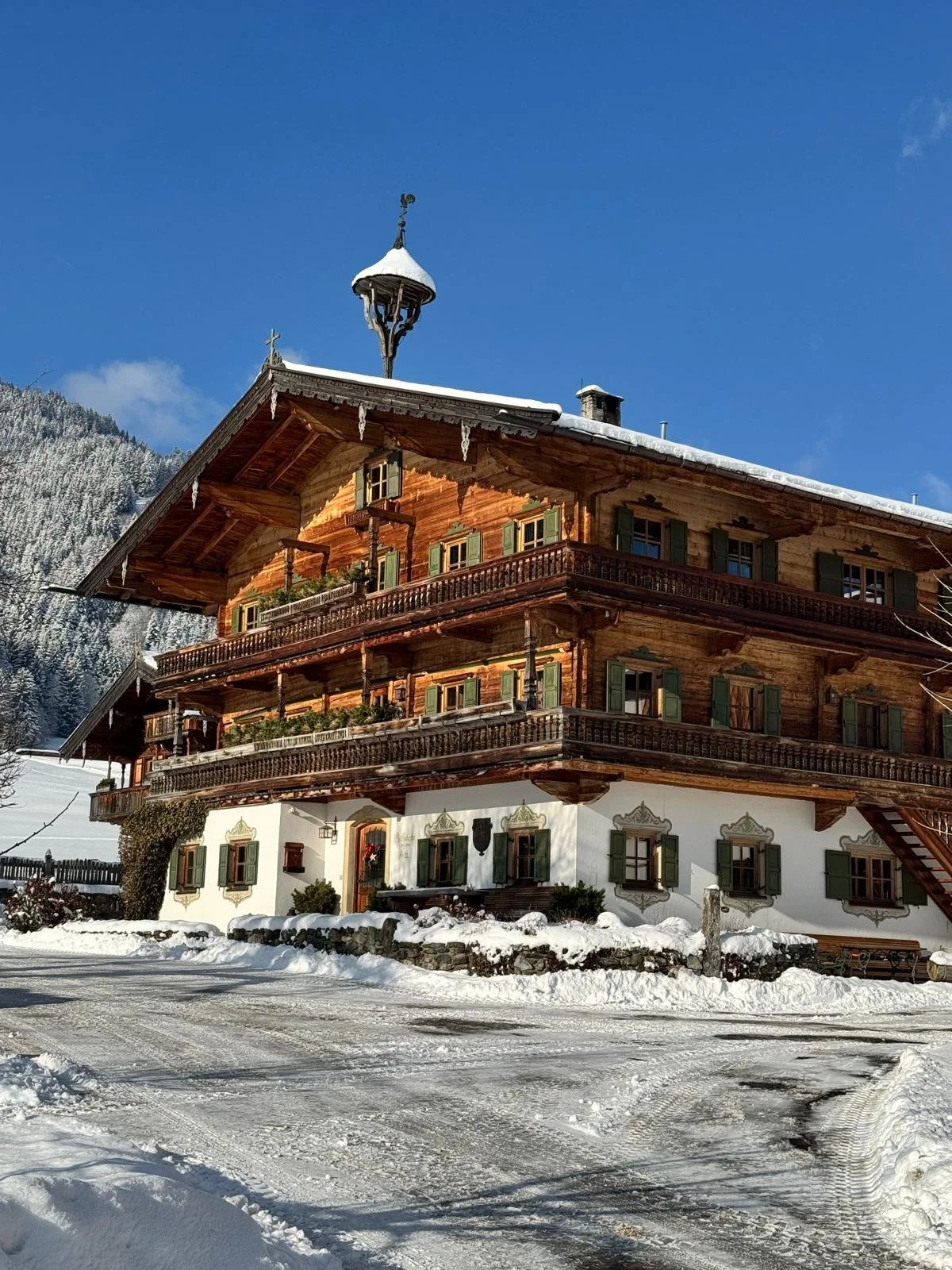
There are Sivananda Centres throughout the world, yet the nearest one to Ireland is in England. Not all centres offer the TTC. I carried out my TTC in the Tirol Region of Austria. Tirol is a mountainous region, famous for its dramatic Alpine landscapes and traditional villages. Dominated by the Alps, it offers world-class skiing in winter and hiking and mountaineering in summer. The Sivananda Centre is located in Reith bei Kitzbühel in the Tirol Region and is located just a few kilometres from the famous resort town of Kitzbühel. Set amid rolling meadows and mountain scenery rather than steep slopes, Reith is known for its peaceful atmosphere and has been able to preserve the quaint atmosphere of an authentic Austrian farming village.
Popular activities in the environs are; winter sports of all types on advance or practice slopes, hikes by the mountains and lakes, visits to alpaca farms, sampling local Austrian cuisine, resting in wellness spas and more.
The Sivananda Retreat Centre
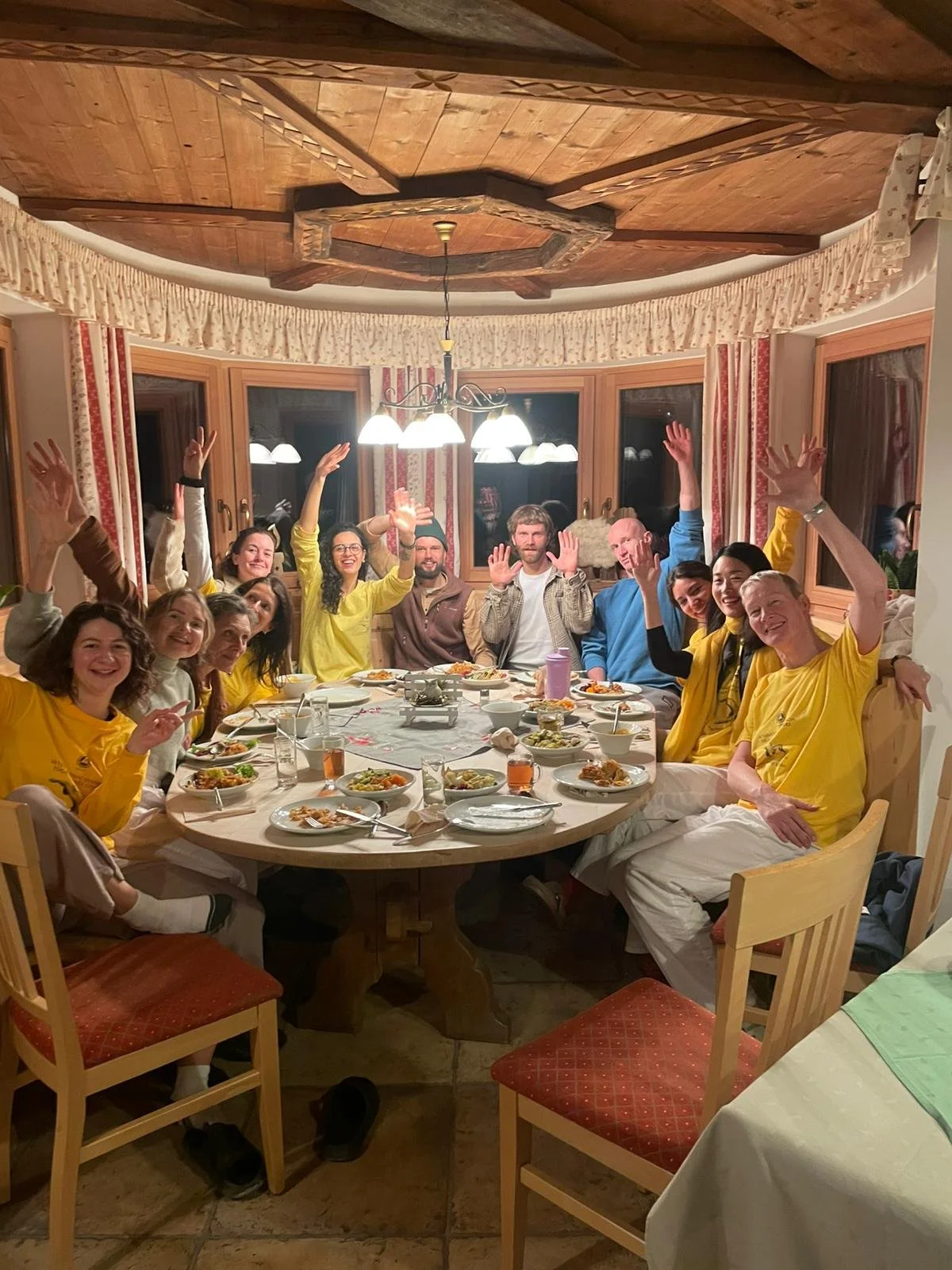
The centre in Tirol is unique as it is part of a hotel. Thus, it is not only able to host, accommodate and feed TTC students, but it also offers several retreats during the year. During my stay, there was the special Christmas and New Year program which was attended by a few hundred guests. The hotel is family run and organic; thus, all food is home cooked using organic ingredients which adhere to a yogic diet (vegetarian but includes dairy). The buildings are heated exceptionally well and after a long walk in the snowy mountains, one is able to warm their bones in the 90-degree sauna. Check out the website to see if any retreats would appeal to you. Of course, the twice daily yoga classes, the twice daily chanting and the daily lectures on spiritual topics are included.
Yoga Retreats, Yoga Teacher Training & Online Live Yoga - Sivananda
Daily Routine
· 5:30 am; Wake up and quick shower
· 6 am; Communal Satsang or spiritual gathering in the main hall; 20 minutes of meditation followed by singing of mantras (kirtan), a talk on a spiritual topic, more chanting, and Ārati, a Hindu ritual of offering light to the Divine as an expression of devotion, gratitude, and reverence.
· 8 am; Yoga Class for the TTC
· 10 am; Bruch and a walk in the mountains, relaxation time
· 12 pm; TTC Lecture, usually on the text called the Bhagavad Gita which is a dialogue between Prince Arjuna and Lord Krishna. The Gita emphasizes living a balanced life, performing one’s duty without attachment to results, and realizing the unity of the individual soul with the divine.
· 1 pm; Snack and free time
· 2 pm; TTC Lecture (Philosophy or Anatomy & Physiology)
· 4 pm; How to teach yoga practical class
· 6 pm; Dinner
· 8 pm; Communal Satsang (same as morning)
· 10 pm; Bedtime
My Learnings
Importance of relaxation;
Productivity is given so much praise these days. When is the last time you heard someone tell you, “Well done for sitting down and doing nothing!”? It is more likely that you were told, “Wow, fair play for going to the gym before getting the kids ready for school, dropping them off, and going to work!”. While we live in an age where we strive for perfect health, why do we still put productivity on a pedestal and hide relaxation in the shadows? It is scientifically proven that stress hormones decrease health, and that relaxation hormones increase health. That energy you feel when you are hustling and bustling about your day? That energy is actually the hormone adrenaline; a stress hormone your body makes to give you emergency fuel when you don’t have any. This emergency supply can’t last forever.
As you can see from my schedule, my time at the TTC was busy, but busy with relaxation. There was a time for silence, for singing, for walking, for resting, for eating and for conversation. The TTC was strictly caffeine free so I had to sacrifice my daily morning black tea with milk. Wow, I did not realise how much caffeine was in 1 cup of tea until I had to do without; what followed were daily headaches and complete full body fatigue for several days. I had no other choice but to grin and bear it. To replace the warm morning drink, I bought decaf coffee with oat milk which satisfied the taste. Day by day, with the passage of time, with all the breathwork and yoga postures, my body detoxed and my headaches disappeared. My body felt reenergised and I was not missing the tea! The few days of struggle showed me how tired my body actually was; the tea was just masking the fatigue. My mind had to come to accept that my body was tired and that this was okay. My body needed rest. Due to personal heath reasons, I have been taking my basal body temperate these past months-spikes and irregularity indicate stress. Tracking my temps during my time at the centre, I noticed my numbers were low and consistent; the decrease showed that before, my “adrenaline” had been causing my higher temps and the consistency showed my nervous stable was now more stable. With my relaxed days, long final relaxations, breath work, lack of caffeine, my nervous system was down regulating! Let’s start reclaiming pride is being slow, steady and serene!
Yoga and Ayurveda;
As an Ayurvedic Practitioner, I view life through the 3 doshas, Vata, Pitta and Kapha, and the 5 elements, Ether, Air, Fire, Water, Earth. Everything about the Sivananda way of life, to me, felt like Vata, or rather, Ether and Air. The qualities of light, dry, cool, rough, subtle, mobile were everywhere; from the rough wake-up call at 5 30 am, to meditating in the cool morning air, the light, dry vegetarian diet, the subtle practice of breathwork and the mobile postures, and the goal to become less identified with the physical body and more with the ethereal and eternal soul. As a person with a current Vata imbalance, that is, I have excess ether and air, which leads to imbalances such as insomnia, constipation, anxiety and all ailments with the qualities of light, dry, cool, rough, subtle, mobile. Thus, engaging in the practices, I knew deep in my heart that there were not wholly serving me. I would need to make adjustments to suit my mind-boy type; adding animal protein to my diet, more fun and less study of philosophy, less strict wake times and so forth. Nothing in life is black and white. We must alter everything for our own individual constitution. That being said, there are many aspects of Sivananda that suit a Vata type (relaxations, calming breathwork, meditation). For the Pitta, again the relaxations, the meditation and the cooling breathwork are suitable, but one must be cautious about being too strict, studying scriptures too much, or practicing too many asanas. For the Kapha, the early wake times, the physical postures and the vegetarian diet are perfect. However, one must be careful not to do too many final relaxations as Kaphas already sleep too much-your yogi friend on the mat beside you who is snoring, that’s the Kapha!
Spiritual Philosophies;
I arrived at the centre full of enthusiasm. I chose Sivananda because I loved the chanting, the philosophy and the structured way of life. However, as the days passed, resistance surfaced. Why did they have to wake at 5 30 am? Why did they have to sing all the time? Why did we have to wear certain colours? Why were they talking about souls and past lives all the time? Why can’t we just live the life we have now to the fullest and enjoy it? This internal friction was not new to me. I have noticed that whenever I dive into another way of life, while excited before I arrive, when there, I experience similar thoughts. Strange.
Anyway, these doubts were gaining steam each day; my initial desire was clouded. To me, the story of Brahman and Atman, of Karma and Reincarnation, makes total sense and can answer all of life’s questions. Expect, the fact that what it is based on is a theory. There is no proof. In fact, the more I reflected, the more I asked myself, how do we know that anything exists? Is this just my reality? Maybe you have your own reality? Maybe you don’t even exist and just appear in my reality? The more I pondered, the less I connected to a spiritual view and the more I identified with Nihilism, which is a view that life lacks inherent meaning, purpose, or objective values. So, I approached a teacher, and expressed my concerns and posed my questions regarding their philosophy. The essence of what he said was this; I was correct, there was no “proof” for any spiritual or philosophical view on life, however, one can choose a way of life that is true for them, and the “proof” is that is brings them peace in their own life. I was taken aback by his honesty. This felt life a huge burden off my chest. I did not have to logically believe in a certain philosophy and know it to be certain; it was enough to feel in my heart that it was true for me. Whatever parts of the practice that served me I could keep, those that did not, I could discard. In this sense, Nihilism, while often thought of as pessimistic, can be liberating. When you know that no system is true, you are prompted to make meaning of life from whatever you choose.
Conclusion
My 4-week Yoga Teacher Training Course has ended. I am home back in Ireland and already my life at the Sivananda Centre feels like a distant memory. My yoga practice is slipping, my meditations are sparse and my chanting is non-existent. However, I am trying my best and that is good enough. I am still off the caffeine, trying to dedicate at least 30 minutes of my day to a spiritual practice, and most importantly, to bring the peace and calmness I nurtured there to my everyday life.
Inspired my TTC, I am going to offer an 8-week Sivananda Yoga Beginner Course to anyone who would like to in Waterford. It would be an honour to share the gift of deep relaxation with others. To find out more, or avail of any of my Ayurvedic knowledge or services, please visit www.anamatma.com, or find me on Instagram @anam_atma
Yours truly,
Aoife
x